Japanese Garden Ideas: 6 Principles That Actually Define It
Not lanterns and red bridges — the six rules underneath, and how to use them in an ordinary yard.
Garden DremiAI: AI Yard & Landscape Design
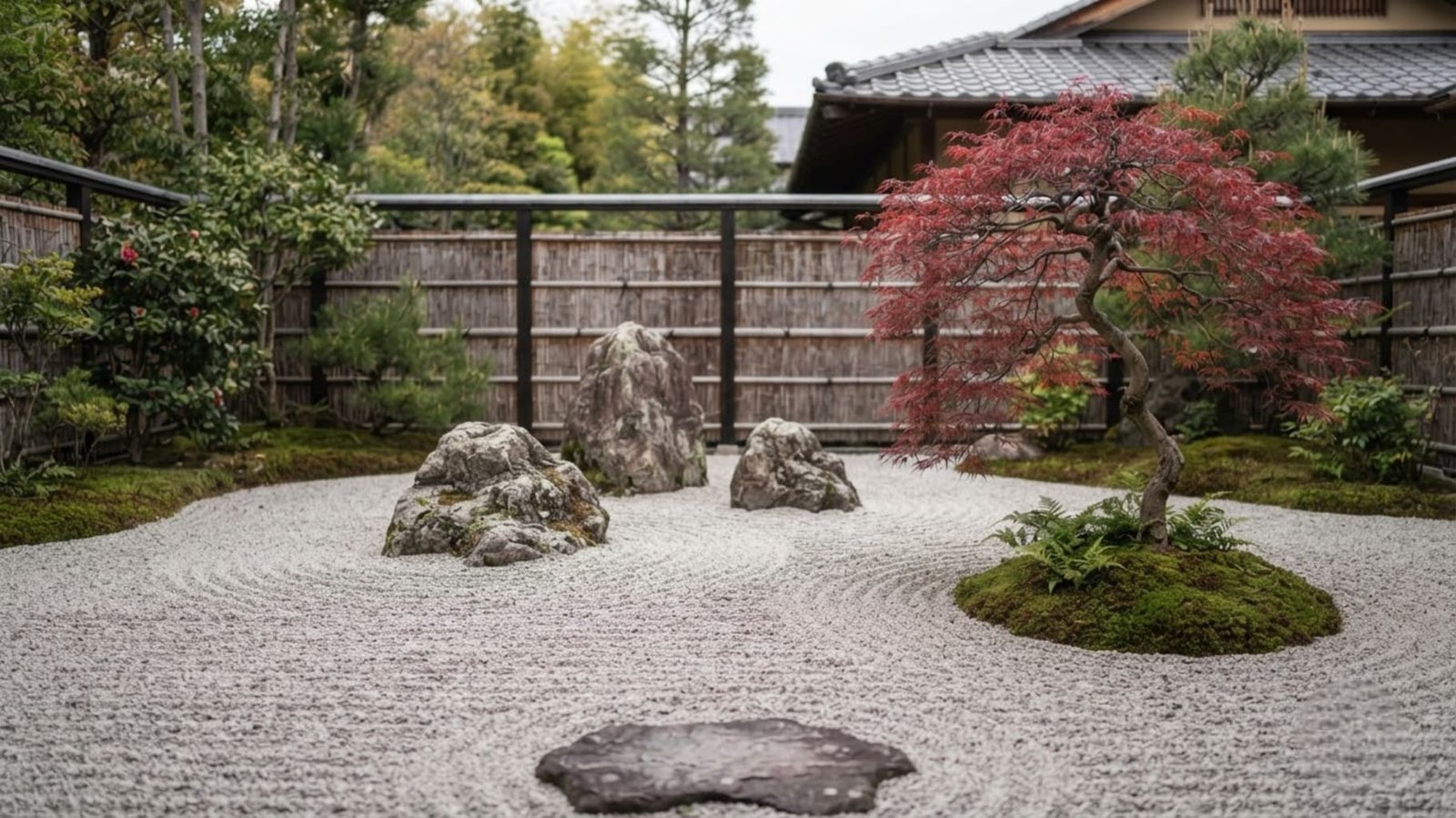
🪨 What actually makes a garden Japanese
A Japanese garden is defined by restraint, not by ornaments. Six principles do the work: asymmetry, deliberate empty space, borrowing the view beyond your boundary, a very small plant palette, hiding part of the garden from every viewpoint, and materials that look older than they are. Get those right with gravel, stone and three plants and it reads as Japanese. Get them wrong and no amount of lanterns will rescue it.
This is the style most often attempted and most often missed, because the visible features — the stone lantern, the arched bridge, the raked gravel — are the easy part to copy and the least important part of the idea. A garden with all three and none of the principles looks like a restaurant forecourt. A plain yard with three rocks placed properly does not.
It is also one of the best styles for a small or shaded space, which is where most people actually need help.
🧭 The six principles
- Asymmetry, always. Nothing is centred, nothing is mirrored, nothing comes in twos. Group stones and plants in odd numbers and set them off-axis. If you catch yourself balancing one side against the other, you have drifted into a European formal garden.
- Empty space is a material. Gravel, moss or plain ground is not the gap between the interesting things — it is one of the interesting things, and it needs as much area as everything else combined. Most attempts fail here, by filling the space they were supposed to leave.
- Borrow the view beyond the fence. A neighbour’s tree, a distant roofline, a hillside — frame it deliberately with planting so it becomes part of your garden. This is the cheapest trick in the entire style, and it makes small gardens feel limitless.
- Very few species, repeated. Three or four plants for an entire garden is normal. The interest comes from form, texture and the way light moves through them — not from variety. Every extra species dilutes the effect.
- Never show the whole garden at once. Something should always be hidden — around a screen, behind a shrub, past a turn in the path. A garden you can take in from the doorway is finished in three seconds. One that conceals a corner stays interesting for years.
- Everything should look older than it is. Weathered stone, moss in the joints, timber left to silver. New, clean and sharp-edged is the opposite of the intent. Buy reclaimed where you can, and resist the urge to pressure-wash.
If you only take two: leave more empty space than feels comfortable, and use fewer plants than you want to. Those two alone get most gardens ninety percent of the way there.
🎨 The palette: materials and plants
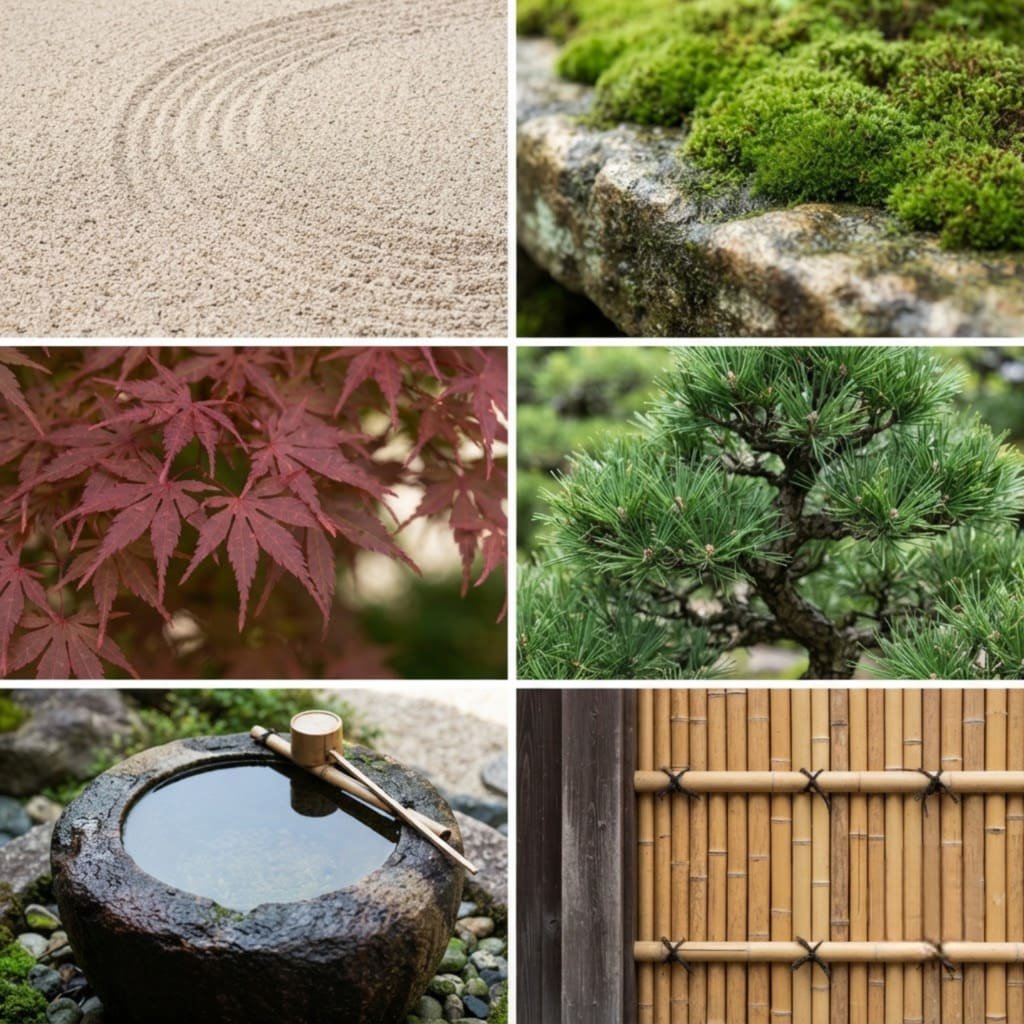
| Element | Use | Note |
|---|---|---|
| Gravel | The main ground surface | Pale grey, fine, angular. Raked or plain — both are correct. |
| Stone | Boulders in odd groups, stepping stones | Bury a third of each boulder. Stones sitting on the surface look dropped. |
| Moss | Softening stone edges and shade | Needs damp shade. See the climate section below. |
| Water | A stone basin, or a still shallow pool | Small and quiet beats large and splashing. |
| Timber & bamboo | Screens, fencing, simple structures | Left unfinished to weather grey. |
| Maple | The one specimen tree | Fine foliage, sculptural in winter. Shelter from wind and hot sun. |
| Pine | Structure and year-round form | Cloud-pruned if you enjoy the work; unpruned is fine too. |
| Clipped mounds | Soft repeated shapes at low level | Azalea traditionally — any tight evergreen shrub works. |
🌍 Making it work in your climate
The style travels well because it is built on form rather than on specific plants. Keep the shape each plant provides and swap the species for something local — the approach is set out in the guide to AI garden design generators. The common substitutions:
| Problem | What to do instead |
|---|---|
| Too dry or sunny for moss | Use fine gravel, a low creeping thyme, or a tight sedum. Gravel alone is entirely authentic. |
| Maples scorch in your summer | Plant in afternoon shade, or substitute a small local tree with fine foliage and good winter structure. |
| Hot dry climate overall | Lean toward the gravel-and-stone version of the style. It is genuinely well suited to drought, and needs almost no water. |
| Cold winters | Increase the evergreen share and choose stone that tolerates freeze-thaw. The style looks excellent under snow. |
| Heavy clay or poor drainage | Raise the planting areas slightly and bed stones on a free-draining base rather than into wet ground. |
One serious warning about bamboo. Running bamboo spreads aggressively through underground rhizomes, will cross into neighbouring properties, and is extremely difficult and expensive to remove once established — in some regions it creates genuine legal liability. If you want bamboo, plant a clumping type, and even then consider a root barrier. Bamboo screening panels give the same look with none of the risk.
⚠️ Six mistakes that turn it into a theme park
- Ornament overload. A lantern, a pagoda, a bridge and a statue in one small garden is decoration, not design. One well-placed object, or none, is the correct number.
- A bridge over nothing. A bridge crosses water or a dry stream bed. Placed on flat gravel it reads instantly as ornament.
- Bright mixed flowers. Colour is used sparingly and seasonally. A border of mixed bedding beside raked gravel fights the whole idea.
- Symmetry that crept in. Matching pots either side of a step, a plant balanced against another. Easy to do without noticing, and it undoes the effect immediately.
- Raked gravel you will not maintain. Raked patterns need re-raking after wind, rain, cats and leaves. If that is not realistic, use plain gravel — it is no less authentic and looks calm rather than neglected.
- Stones placed like objects. Boulders should look as though the garden was built around them. Bury the base, group them in threes, and vary the sizes.
This style suits small and enclosed spaces better than almost any other, because concealment and restraint are easier in a courtyard than across a large lawn — more on that in small backyard layouts.
📱 See it on your own yard first
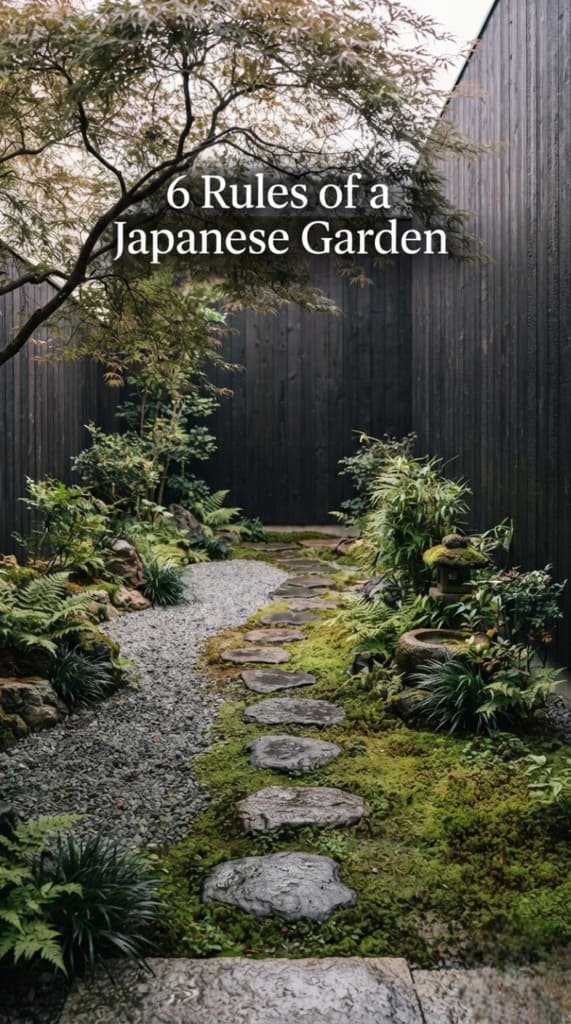
Japanese is one of the hardest styles to picture in your own space, because it depends so heavily on proportion and empty ground — exactly the things a photograph of somebody else’s garden cannot tell you. Take one photo of your yard, choose the Japanese zen style in Garden DremiAI, and you will see it applied to your real boundaries in about thirty seconds.
Worth doing twice: once as-is, and once after clearing the clutter out of frame. The difference is usually startling, and it tells you how much of the effect is simply restraint. The app also identifies any plant from a photo and gives it a watering plan — useful when you are choosing local substitutes at the nursery. Free on iPhone and Android, first design free, no account needed.
Read next: the full AI backyard design guide · 12 small backyard layouts · how garden generators work
❓ FAQ: Japanese garden design
Q: What makes a garden Japanese?
A: Six things: asymmetry, generous empty space, borrowing the view beyond the boundary, a very small plant palette, hiding part of the garden from every viewpoint, and materials that look weathered. Ornaments are optional and usually overused.
Q: Can I make a Japanese garden in a small yard?
A: It is arguably the best style for one. Concealment, restraint and careful proportion are far easier to achieve in a courtyard than across a large open lawn, and the style needs no lawn at all.
Q: What plants do I need?
A: Very few — three or four species is normal. A fine-foliaged small tree, something evergreen with structure, a tight clipped mound and a ground layer of moss or gravel will carry an entire garden.
Q: I can’t grow moss where I live. Does that ruin it?
A: Not at all. Fine gravel is completely authentic and is the dominant ground surface in many of the best-known Japanese gardens. Creeping thyme or a low sedum also work as substitutes in dry sunny sites.
Q: Should I plant bamboo?
A: Be careful. Running bamboo spreads through underground rhizomes, crosses boundaries, and is very costly to remove — in some places it creates legal problems with neighbours. Choose a clumping type with a root barrier, or use bamboo screening panels instead.
Q: Is a Japanese garden high maintenance?
A: It depends entirely on which version. Gravel, stone and a few evergreens is among the lowest-maintenance styles there is. Raked patterns, cloud-pruned pines and clipped mounds are a genuine ongoing commitment — choose deliberately.
Q: How do I stop it looking like a garden centre display?
A: Cut the ornaments to one or none, remove any symmetry, bury a third of every boulder, and leave more empty ground than feels right. Almost every unconvincing Japanese garden is over-decorated and under-empty.
🧑💻 About the Author
Garden DremiAI — AI yard design & plant care
Written by the maker of Garden DremiAI, an independent studio. Japanese is the style our users generate most and copy least successfully, and the pattern is always the same — too many objects, not enough empty ground. Plant choices should be confirmed locally; species suited to one climate frequently fail in another.
Questions: support@gardenyarddesign.com