AI Landscape Design: What It Can Plan and What It Can’t
Landscape design is the whole property — levels, water, access and structure. Here is exactly where AI helps at that scale, and where it stops.
Garden DremiAI: AI Yard & Landscape Design
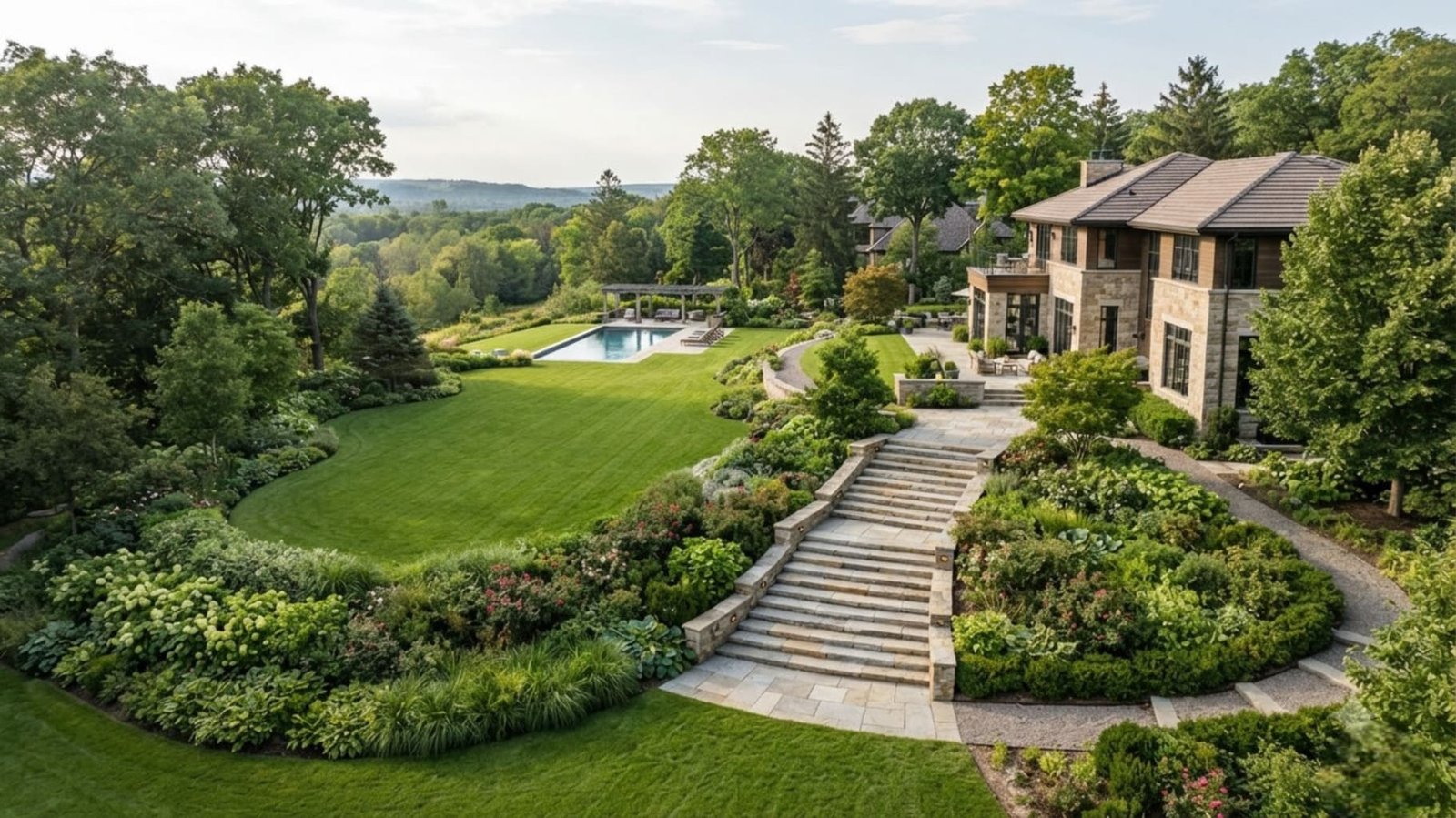
🗺️ Garden, yard, landscape — three different jobs
AI landscape design applies a style to a photo of your outdoor space and returns a photorealistic result in about 30 seconds. At the scale of one yard that is often all you need. At the scale of a whole property it is a starting point only — because landscape design is really about levels, water, access and structure, and none of those are visible in a photograph.
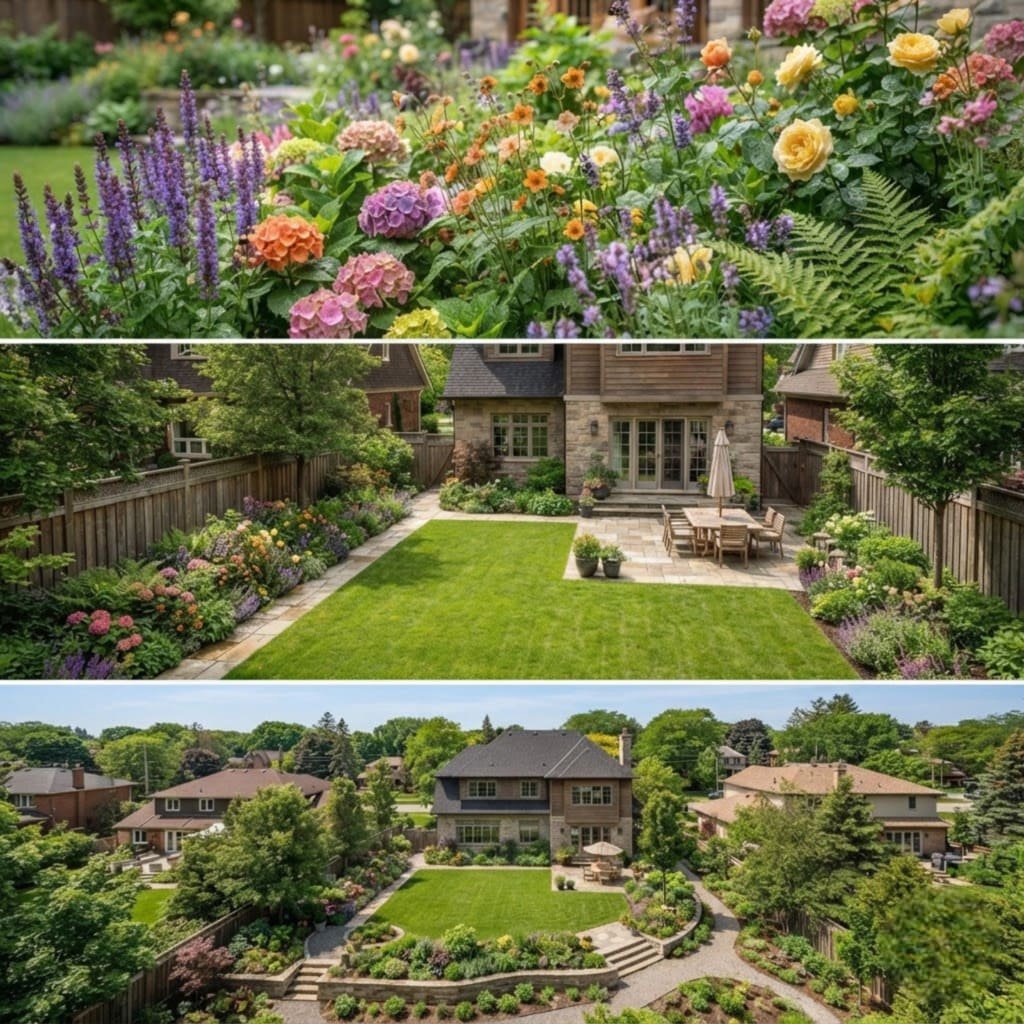
The three words get used interchangeably, and they should not be:
| Term | What it covers | The main question |
|---|---|---|
| Garden | Beds, borders, planting | What grows here, and will it survive? |
| Yard | One enclosed usable outdoor space | What happens in this space? |
| Landscape | The entire property and how its parts connect | How does the ground work, and how do you move through it? |
🏔️ The four things landscape design is really about
- Levels. Where the ground rises and falls, and what you do about it — terracing, steps, retaining, or simply going with it. This is the single most expensive variable on any property, and it is invisible in a photograph taken straight on.
- Water. Where rain lands, where it collects, and where it leaves. Every hard surface you add displaces water onto something else. On a slope this compounds fast, and it is the failure that damages buildings.
- Access. How you move between spaces day to day — and, separately, how materials and machinery get in during the build. Properties with no side access cost meaningfully more to work on, because everything arrives by wheelbarrow.
- Structure. The permanent bones — mature trees, walls, buildings, changes of level. Everything else is decoration hung on this frame, and the frame is what you should design first.
Notice that three of the four are about the ground rather than the look. That is the honest definition of landscape design, and it is why a beautiful outdoor render is the beginning of the process rather than the end of it.
⚖️ Where AI outdoor design earns its place
| ✅ Genuinely useful for | ❌ Cannot do |
|---|---|
| Choosing one style language for the whole property | Measure gradients or set finished levels |
| Testing whether separate areas look like they belong together | Size or engineer a retaining wall |
| Showing planting at maturity instead of at purchase | Calculate drainage or runoff |
| Settling disagreements before a designer is paid | Know your soil, subsoil or water table |
| Giving a landscape designer a visual brief on day one | Handle permits, protected trees or boundary law |
That first row matters more than it looks. On a property with three or four distinct areas, the most common failure is not that any one space is bad — it is that they were designed at different times and have nothing in common. Running every area through the same style in one sitting is a cheap way to catch that before it happens.
🔗 Making several spaces read as one landscape
Four devices do almost all the work, and none of them are expensive:
- One paving material everywhere. Use a single surface across every hard area on the property, even if the areas are very different in purpose. Nothing unifies a landscape faster or more cheaply.
- Repeat three plants. Choose three species and repeat them in every area, mixed with whatever else suits that spot. Repetition reads as intention, and it costs nothing extra.
- Design the thresholds. The moment you pass from one area to another — a step, a gap in a hedge, a change of width — is what makes a property feel composed rather than chopped up. These transitions deserve more attention than the areas themselves.
- Give the eye somewhere to land. From each main viewpoint, something should be worth looking at in the distance — a tree, a seat, a pot. Long views make a property feel larger and stitch its parts together.
For the hard surfaces themselves — sizes, materials, falls and base depth — the detail is in the patio and hardscape guide. For working out what each area is for before you style any of it, use the six questions on every space separately.
⛰️ If the ground slopes, read this before anything else
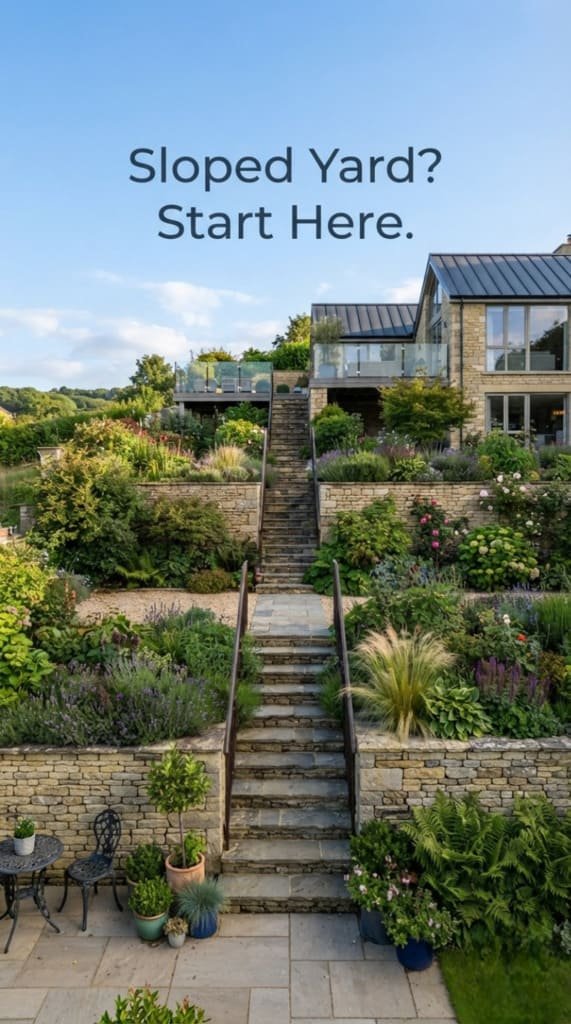
Slope is where AI renders are least reliable and where the money goes. A generated image will happily show a flat terrace on a hillside without any indication of what holds it up. In reality, creating level ground on a slope means cutting into the bank, filling out from it, or both — and whatever holds that new edge in place is a retaining structure.
Retaining is the item most likely to double a landscape budget, because it involves engineering, drainage behind the wall, and frequently permits. Low walls holding back a modest bank are routine work. Anything taller, or anything holding back ground near a boundary or a building, needs a professional to specify — this is not a place for judgement by photograph.
The cheaper alternative is to stop fighting the slope. Planted banks, informal steps following the natural fall, and seating cut into the hill rather than platformed above it all cost a fraction of terracing, and on a gentle gradient they often look better. Generate both versions before you decide — that comparison alone can be worth more than the entire design fee.
📱 Photograph every area, not just the best one
The most useful way to use Garden DremiAI on a whole property is to photograph every area — front, back, side, the awkward corner, the slope — and run all of them through the same style in one sitting. Thirty seconds each, and you end up with a set of images that either hang together or obviously do not.
That set is also the best possible brief for a landscape designer. Arriving with six images showing one consistent direction saves a great deal of the early back-and-forth, and it makes the parts you genuinely need professional help with — levels, retaining, drainage — much quicker to scope. Free on iPhone and Android, first design free, no account needed.
Read next: the full AI backyard design guide · 6 questions before you design a yard · patio sizes and materials
❓ FAQ: AI landscape design
Q: Can AI do landscape design?
A: It can do the visual half — style, planting character, materials and mood, applied to photos of your real property. It cannot do the technical half: levels, retaining, drainage, soil and permits. Both halves are needed, and only one of them is quick.
Q: What is the difference between landscape design and garden design?
A: Garden design is chiefly about planting. Landscape design is about the ground and the whole property — how it drains, how it changes level, how you move through it, and how separate areas relate. Planting is one part of it rather than the point of it.
Q: Is there a good AI outdoor design app?
A: Garden DremiAI works from a photo of any outdoor space — front, back, patio, balcony, pool or slope — and returns a redesign in about 30 seconds. For a whole property, run every area through the same style so the results can be compared.
Q: Can AI help with a sloping yard?
A: For deciding how a slope should look — terraced and formal, or planted and natural — yes, and comparing those two options side by side is genuinely valuable. For how the slope is held up, no. Retaining structures need a professional specification.
Q: When do I actually need a landscape designer?
A: When the property has significant level changes, needs retaining, has drainage problems, includes structures that may require permission, or has mature or protected trees. Also when several areas must work as one composition and you cannot picture how.
Q: How do I make my whole property look designed rather than assembled?
A: One paving material throughout, three plant species repeated in every area, deliberate transitions between spaces, and something worth looking at from each main viewpoint. Those four devices do most of the work at almost no extra cost.
Q: Should I design the whole landscape at once, even if I build it slowly?
A: Yes. Building in phases is normal and sensible; designing in phases is what produces properties made of unrelated fragments. Settle the whole picture first, then build whichever part you can afford.
🧑💻 About the Author
Garden DremiAI — AI yard design & plant care
Written by the maker of Garden DremiAI, an independent studio. Slopes are where our renders flatter most, because a generated image never shows what holds a terrace up — so this page says plainly that levels and retaining belong to an engineer, not to a photograph.
Questions: support@gardenyarddesign.com